
 Guide
GuideCash for Keys in NJ: The Complete Seller Guide
Cash for keys in NJ explained. What it pays, how the handover works, and what happens if a tenant stalls. Get a real cash offer in 24 hours, no.
Last month we sat down with a Camden landlord who had already tried everything. Certified letters. Informal offers. One phone call that ended badly. His tenant owed four months of rent and had no plan to leave. He asked us whether cash for keys was even worth attempting. We told him yes. But only if he understood exactly how the handover works, what to do when a tenant takes the money and stalls, and how the security deposit fits into the deal. That conversation is what this guide is. Cash for keys is one of the most misunderstood tools in New Jersey real estate. Most articles stop at "get it in writing." This one goes further. We cover the actual logistics, the failure scenarios, the NJ-specific costs, and the step-by-step process that determines whether a cash-for-keys deal closes cleanly or drags into a lawsuit.
Cash for keys is a voluntary, written agreement where a property owner pays a tenant to vacate by a specific date, avoiding the NJ Superior Court eviction process.
What Is Cash for Keys, Exactly?
Cash for keys is a voluntary deal between a property owner and a tenant. The owner hands over a lump-sum cash payment. The tenant agrees to move out by a set date and return the keys in good condition. That's it. In New Jersey, a formal eviction runs through the NJ Superior Court, Special Civil Part. A contested case typically takes 3 to 6 months from filing to lockout, sometimes longer if the tenant requests adjournments. Filing fees, attorney costs, and lost rent during that stretch commonly add up to $4,000 to $8,000 before you see a lockout order.
Cash for keys cuts that timeline short. You negotiate directly with the tenant, put the terms in writing, and exchange payment for keys on move-out day. That closes the chapter in days, not months. If you also want to sell the property afterward, this guide connects directly to our broader Cash Home Buyer process. We buy occupied homes in any condition across Camden, Gloucester, Burlington, Atlantic, Cumberland, Salem, Cape May, and Ocean counties.
NJ is a court-controlled eviction state. Contested cases average 3-6 months and $4,000–$8,000 in direct costs before a lockout order is issued.
We operate in a judicial eviction state. Every formal eviction in New Jersey needs a court hearing, a judge's order, and a separate warrant for removal served by a Special Civil Part Officer. That process costs real money and real time. Those two costs together become your benchmark when you sit down to figure out what to offer a tenant to leave on their own.Most NJ cash-for-keys agreements land between $500 and $5,000, calibrated against the avoided cost of a formal eviction and the tenant's actual moving expenses.
There is no statewide minimum for cash-for-keys payments in New Jersey. That is different from some California jurisdictions that set bedroom-based floors. The number is negotiated. Across South Jersey, most agreements land between $500 and $5,000 depending on the tenant's situation, the rent level, and how far along any eviction filing already is. Our formula is simple: estimate what a contested eviction would cost you in legal fees, court time, and lost rent, then offer the tenant a fraction of those savings in exchange for a clean, fast exit. A tenant who gets $1,500 to vacate in 30 days and avoids an eviction on their rental history has a real reason to cooperate. As one practitioner in the space put it plainly: "I'll sit down with you and build a real seller net sheet: my offer minus title fees, prorated taxes, any lien payoffs, and transfer taxes. You should leave that conversation knowing exactly what wire hits your account on closing day, not a ballpark." We hold cash-for-keys offers to that same standard. Every number goes on the table before anyone signs anything.
The Actual Day-of Handover: Step by Step
A clean cash-for-keys handover requires a signed agreement, a move-out inspection, documented unit condition, and simultaneous key and payment exchange on the agreed date.
Most articles jump straight from "sign the agreement" to "tenant moves out." Everything that happens in between is where deals fall apart. Here is what a real handover looks like.
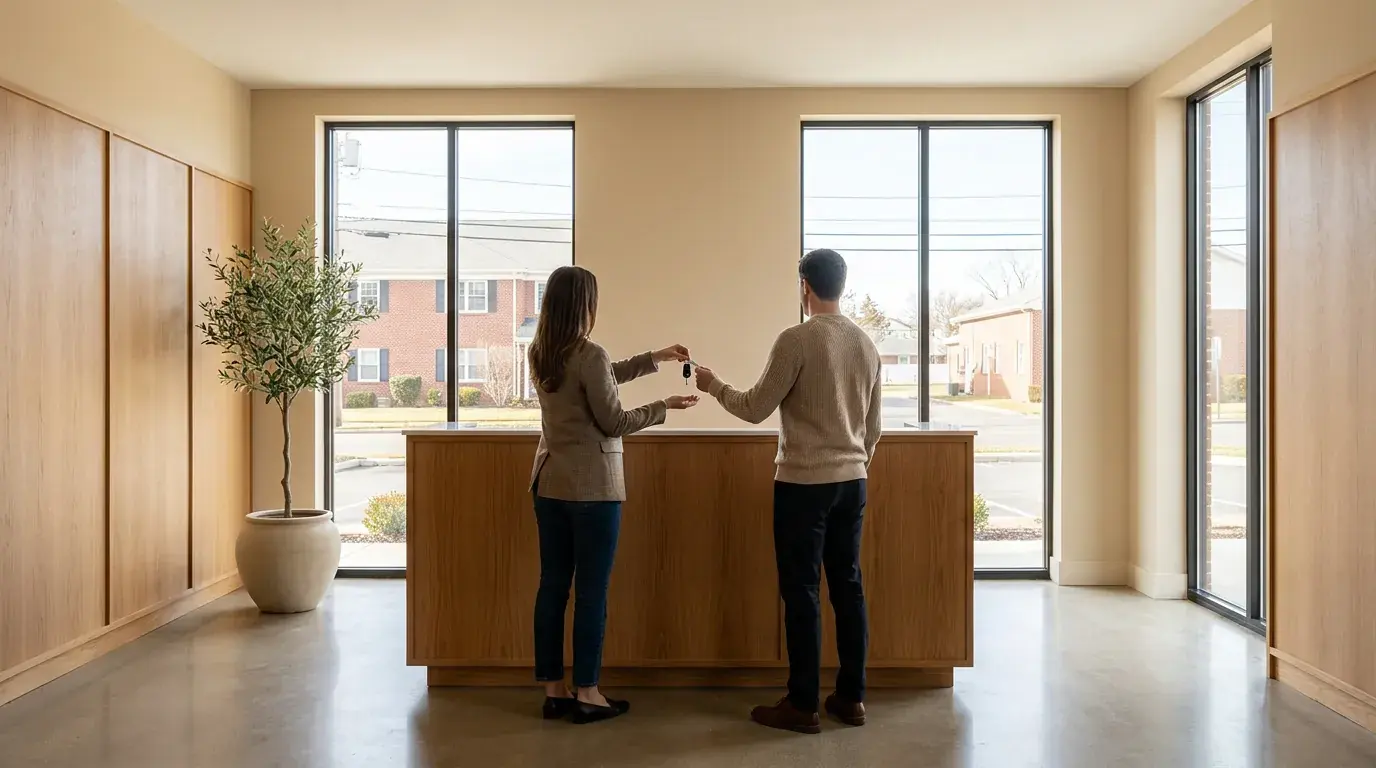
On move-out day, meet the tenant at the property at the agreed time. Do not hand over the check or cash before you walk the unit together. Go through every room with the tenant present. Bring a written move-out checklist that mirrors the move-in condition report you already have on file. Photograph every wall, floor, appliance, and fixture with a timestamp. Note any damage that goes beyond normal wear and tear. Both parties sign the checklist before anything else happens.
Then you swap the payment for every key, fob, garage remote, and mailbox key. Get everything in one hand before the check leaves yours. That simultaneous exchange matters legally. If a tenant pockets the money and hands you one key while keeping a spare, you have a real problem on your hands. Write down the serial numbers or cuts of any returned keys if your locks can be re-keyed. Change the locks within 24 hours of the exchange. That single step closes the door on a long list of headaches before they start.
- Make the Initial Offer. Approach the tenant in person or in writing with a specific dollar amount and a specific move-out date. Do not make vague offers. Give them 5 to 7 days to respond. Document the offer in writing even at this stage.
- Negotiate and Draft the Agreement. If the tenant counters, negotiate on dollar amount and move-out date. Once terms are agreed, put everything in a written agreement signed by all tenants on the lease. Include the payment amount, move-out date, unit condition expectations, key return requirements, and what happens to the security deposit.
- Confirm Move-Out Logistics. A week before the move-out date, check in with the tenant. Confirm they have a place to go. Offer to connect them with local resources if they are struggling to find housing. A tenant with nowhere to go on move-out day is the most common reason deals collapse at the last minute.
- Conduct the Move-Out Walk-Through. On move-out day, walk every room together. Use a timestamped photo checklist. Note any damage. Both parties sign the condition report before any payment changes hands. This protects you if there is a dispute later.
- Exchange Keys and Payment Simultaneously. Hand over the agreed payment. Certified check, cashier's check, or wire transfer. At the same moment the tenant hands over every key, fob, and access device. Change the locks within 24 hours. You are done.
What Happens When a Tenant Takes the Money and Stalls?
If a tenant accepts payment and does not vacate by the agreed date, the landlord's remedy in NJ is a breach-of-contract claim in Special Civil Part, not a self-help lockout.
Nobody in this space wants to answer this question honestly. We will.
A tenant who takes a cash-for-keys payment and then refuses to leave on the agreed date has broken a contract. Your remedy in New Jersey is not to change the locks yourself. Self-help lockouts are illegal in NJ, no matter what the agreement says. Your remedy is a breach-of-contract action in Special Civil Part. That route is faster than a standard eviction, but it still requires a court date. The written agreement is your evidence.
This is why the agreement must include a specific move-out date, a specific payment amount, and language stating that the payment is consideration for the tenant's agreement to vacate. If the tenant stalls, you have a signed contract to take to court. Without it, you have a verbal promise and nothing else.
We have seen deals fall apart when landlords paid cash up front in two installments without a written agreement in place first. Do not pay a single dime before the ink is dry on a signed document.
Any cash-for-keys arrangement without a signed written agreement is legally unenforceable in NJ and leaves the landlord with no court remedy if the tenant stalls.
Most landlords who get burned on cash for keys skipped the written agreement because the conversation felt friendly. Here is the reality: a verbal cash-for-keys arrangement is not enforceable in New Jersey courts. If a tenant takes $1,000 and refuses to move, your signed agreement is the only document that gets you in front of a judge. Without it, you start the eviction process from zero. You are also $1,000 poorer. Friendly conversations do not substitute for signed paperwork. Full stop.How Does the Security Deposit Factor In?
New Jersey law requires security deposits to be returned or itemized within 30 days of a tenant vacating. A cash-for-keys agreement does not automatically waive or absorb the deposit.
Security deposits trip up more cash-for-keys deals than almost anything else. Here is the short answer: the security deposit is a separate legal obligation under the New Jersey Security Deposit Act (N.J.S.A. 46:8-19 et seq.), and a cash-for-keys agreement does not wipe it out automatically. You have two options. First, address the deposit directly in the agreement. Return it at key exchange, deduct documented damage costs and return the balance, or fold the deposit amount into the buyout total so the tenant receives one net payment that covers both. Second, handle the deposit on its own under the standard NJ timeline. That timeline requires you to return the deposit or send an itemized deduction statement within 30 days of the tenant vacating. Miss that 30-day window without a written itemization and the tenant can sue for double the deposit amount plus attorney fees under NJ law. Spell it out in the agreement. Ambiguity here costs real money. If you are a landlord planning to sell after the tenant leaves, also review the NJ Division of Taxation. Realty Transfer Fee. That fee applies to every NJ deed transfer, including cash sales.
Cash for Keys vs. Formal NJ Eviction: The Real Comparison
| Cash for Keys | NJ Superior Court Eviction | |
|---|---|---|
| Typical timeline | 14 to 60 days | 3 to 6+ months |
| Direct cost to landlord | $500 to $5,000 (buyout payment) | $4,000 to $8,000+ (attorney, filing, officer) |
| Court involvement | None | Required — Special Civil Part hearing plus warrant for removal |
| Tenant's rental record | No eviction filing appears | Eviction is public record — harms tenant's future rental applications |
| Unit condition risk | Lower — tenant leaves voluntarily, often cooperatively | Higher — contested tenants sometimes damage units before lockout |
| Enforceability if tenant stalls | Breach-of-contract claim with signed agreement | Warrant for removal served by Special Civil Part Officer |
| Flexibility on move-out date | Negotiable | Set by court order — no flexibility |
What About Multiple Tenants on One Lease?
All tenants named on a NJ lease must sign the cash-for-keys agreement for it to be enforceable. A single signature from one roommate does not bind the others.
This comes up more often than people expect. It happens a lot in larger rentals across Burlington and Camden counties, where multi-tenant leases are common. If three people are named on the lease and only one signs the cash-for-keys agreement, the other two are not legally bound. They can stay. The one who signed is in breach of a contract the other two never agreed to. That is a real problem. The rule is simple: every adult on the lease must sign. All of them.
Payment needs to be spelled out clearly too. If you are paying $3,000 to a household of three tenants, the agreement should say exactly how that money is divided or who receives it. If the three roommates disagree on how to split it, that is their problem to work out before signing. Not after. Make clear in the agreement that the total payment is the total, not a per-person figure, unless you mean it to be. We have seen disputes between roommates freeze a deal for weeks because this one detail was left vague. Write it down.
Tax Implications: What Landlords Often Miss
Cash-for-keys payments made to tenants are generally deductible as ordinary business expenses for NJ landlords, but the IRS requires proper documentation and the payment must be substantiated.
Here is something most landlords never hear until it costs them money. In most cases, a cash-for-keys payment you make to a tenant is deductible as an ordinary and necessary business expense under IRC Section 162. It is a cost of running your rental property, plain and simple. Keep the signed agreement, the payment receipt, and the canceled check or bank record. That paper trail is what holds up the deduction if the IRS comes asking.
The tenant's side is a separate question. A cash-for-keys payment a tenant receives may be taxable income, depending on their situation. That is their problem to sort out with their own tax advisor, not yours.
On the sale side, if you are selling after the tenant walks out, know this: IRS tax liens attach to all real property and follow the title. Any liens on the property must be resolved at or before closing. A lien subordination or discharge from the IRS typically takes 30 to 45 days, even when you ask for a rush. Build that window into your timeline if it applies to your deal. For properties carrying NJ property-tax arrears, the NJ Division of Taxation. Property Tax Relief page has useful detail on balances and credits.
When Cash for Keys Meets a Property Sale
Selling a tenant-occupied NJ property can pair with a cash-for-keys agreement. Cash buyers like Elite Home Buyers price repairs themselves and can close around tenant situations.
Selling while a cash-for-keys deal is still in motion is more complicated than most sellers expect. Here's something we're honest about: when we started buying properties in 2018, we underestimated how often both things happen at the same time. We used to tell landlords to resolve the tenant situation completely before calling us. That was the wrong advice.
Landlords who wait for a fully vacant unit can bleed months of carrying costs before they even list. We don't ask you to wait anymore. We work with landlords mid-process, and we can build our purchase around your cash-for-keys timeline. In many cases, we take over the buyout negotiation entirely as part of the deal.
Every house qualifies, no matter the condition. We price the repairs in ourselves. You don't fix anything. That applies to properties with tenants still inside. Our purchase agreement carries no financing contingency, no appraisal contingency, and no sale-of-other-home contingency. What the contract says is exactly what happens. No surprises at the closing table.
If you're a South Jersey landlord dealing with a difficult tenant right now, two resources will give you a straight read on your options. Our guide on selling with tenants in place in NJ walks through what that process looks like in the field for rental owners. Our eviction vs. Selling your NJ rental guide puts both paths side by side so you can compare the real costs and timeline before you decide.
Elite Home Buyers is BBB A+ rated, has been buying South Jersey homes since 2018, and charges zero fees or commissions on any transaction.
We've been buying homes across South Jersey since 2018, and we hold a BBB A+ rating. We charge zero fees and zero commissions. The number on our offer is the number you walk away with. The only deductions are liens or taxes you already owe before we ever showed up. No surprises at the closing table.- Full Names of All Lease Parties. Every adult named on the lease must be identified and must sign. A partial signature from one roommate is not enough to bind the household.
- Exact Payment Amount and Form. State the dollar figure and whether payment is by certified check, cashier's check, or wire transfer. Avoid cash. It creates proof-of-payment problems.
- Specific Move-Out Date and Time. Name the date and time the unit must be fully vacated. Vague language like 'within 30 days' creates enforcement problems. Use a calendar date.
- Unit Condition Expectations. Describe what condition the unit must be in at move-out. Reference the original move-in condition report if one exists. Note what counts as acceptable wear and tear.
- Security Deposit Disposition. State explicitly whether the deposit is returned at move-out, deducted for documented damage, or folded into the buyout total. This one clause prevents the most common post-agreement disputes.
- Key Return Requirements. List every key, fob, garage remote, and access code to be returned. State that the simultaneous exchange of payment and keys constitutes completion of the agreement.
Pre-Foreclosure, Probate, and Other Situations Where Cash for Keys Comes Up
Cash-for-keys agreements frequently arise in NJ pre-foreclosure and probate situations where heirs or distressed owners need a tenant out before they can sell.
Cash for keys isn't just a landlord tool. It shows up in pre-foreclosure when an owner is behind on payments and needs to sell fast. It shows up in probate when heirs inherit a property that still has a tenant living in it and need to close an estate. It shows up in divorce, when one party needs to cash out of a jointly owned rental. In every one of these situations, the mechanics are the same: a voluntary written agreement, a fair payment, a specific move-out date, and a documented handover. For pre-foreclosure specifically, NJ is a judicial foreclosure state and the courts control the timeline. The NJ Courts. Foreclosure Self-Help page shows what that process looks like from the inside. If you are in foreclosure and also have a tenant in place, two clocks are running at once. Getting a tenant out through cash for keys before the sheriff sale can protect your right to sell voluntarily and walk away with equity. For probate situations, the NJ Courts. Wills, Estates & Probate page explains what the surrogate's court needs before a deed can transfer. Our guides on selling an inherited house with multiple heirs and the NJ probate timeline for real estate walk through the full picture.
These guides cover the most common scenarios where cash for keys intersects with selling, probate, foreclosure, and distressed-property decisions in South Jersey.
If your situation hits close to home, these guides go deeper. How to Sell a Rental Property With Tenants in NJ. Pre-Foreclosure Options in NJ. Selling a House Full of Stuff: The Inherited Home Playbook. Behind on Property Taxes in NJ: What Happens Next. Selling a Fire-Damaged House in NJ. Pick the one that fits your situation and start there.Frequently asked questions
Is cash for keys legal in New Jersey?
How much should a cash-for-keys payment be in New Jersey?
What happens to the security deposit in a cash-for-keys deal in NJ?
Can I use cash for keys to sell my NJ rental property faster?
What happens if a tenant takes cash-for-keys but won't leave?
Get a 100% fair cash sale offer.
No obligations, no fees, no commissions. It costs nothing to know what we’d pay, worst case you turn it down, best case the house is handled by this time next month.
This page is for general informational purposes and is not professional, legal, or medical advice. Elite Home Buyers can advise on your specific situation, contact us for a consultation. Serving Sicklerville, NJ.

Born and raised in South Jersey; founded Elite Home Buyers in 2018. Reviews every offer and every guide the company publishes.